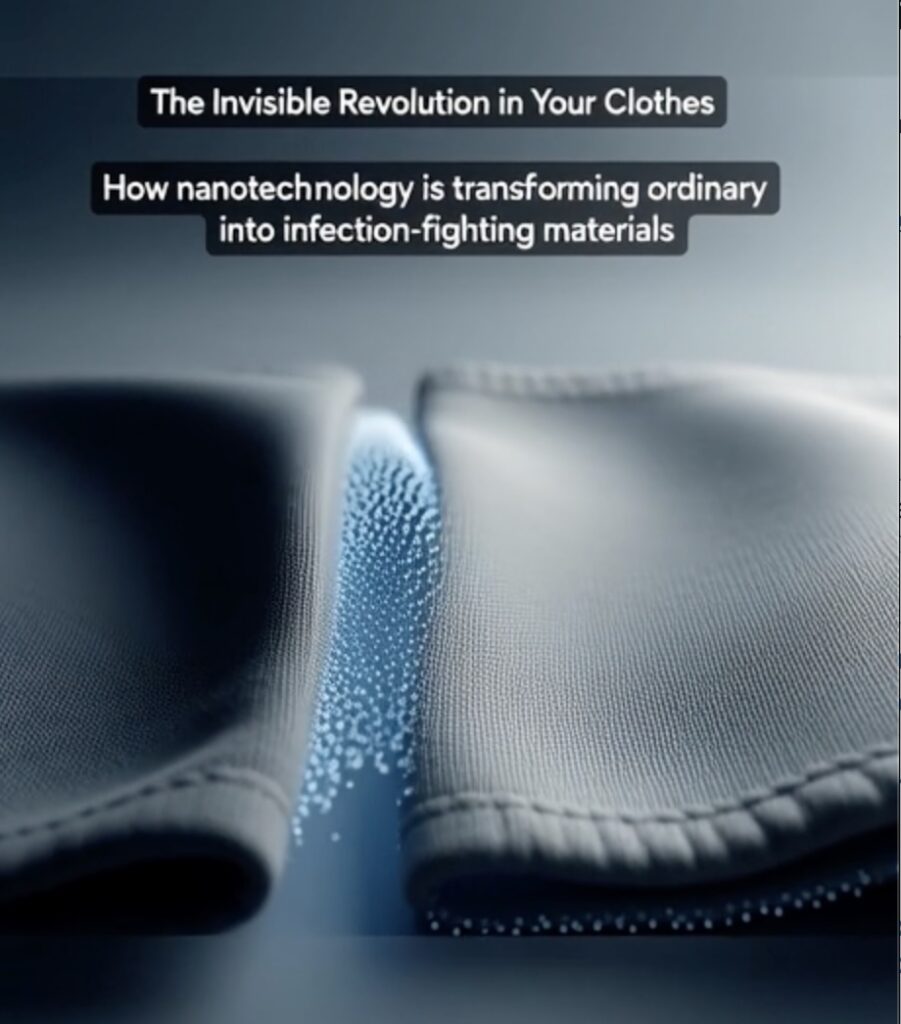
How nanotechnology is transforming ordinary fabrics into infection-fighting materials
There’s a revolution happening in textiles, and you probably haven’t noticed it. The gym shirt you’re wearing, the hotel sheets you slept on last night, or the scrubs worn by your doctor might soon contain something extraordinary: microscopic particles, each one the size of a small virus, actively fighting bacteria and keeping fabrics fresher for longer.
Welcome to the age of antimicrobial textiles, where nanotechnology is turning ordinary fabric into something more like a living defence system.
The Problem We Never Talk About
Let’s start with an uncomfortable truth: fabrics are crawling with microorganisms.
Your gym clothes after a workout? A breeding ground for bacteria. Hotel towels, even freshly laundered ones? Research from the University of Arizona found that nearly 90% harbour coliform bacteria, with 14% carrying E. coli. Hospital gowns and bed linens? They can transmit dangerous pathogens between patients, contributing to the roughly one in ten hospital patients who pick up an infection during their care.
We’ve always known fabrics get dirty, of course. But what’s changed is our understanding of just how significant a problem this is, and our ability to do something genuinely innovative about it.
Why Cleaning Isn’t Enough
Here’s the thing about traditional cleaning: it’s temporary. You wash a hospital curtain or a sports shirt, and yes, it’s clean – for a while. But the moment someone touches it, breathes near it, or it encounters moisture, bacteria begin colonising again. Within hours, you’re back where you started.
This isn’t just about the ‘ick factor’. In healthcare settings, textiles that harbour bacteria can contribute to life-threatening infections. In sportswear, bacterial growth causes that distinctive smell that doesn’t quite wash out. In hotels, it affects guest satisfaction and increases replacement costs. The question became: what if fabrics could actively resist bacterial growth, all the time, without constant intervention?
Enter the Nanoparticle
Nanotechnology operates at a scale that’s difficult to visualise. A nanometre is one-billionth of a metre. To put that in perspective: a human hair is about 80,000 nanometres wide. A silver nanoparticle used in antimicrobial textiles? Often just 10 to 100 nanometres.
At this scale, materials behave differently. Silver has been known for centuries to have antimicrobial properties ancient civilizations stored water in silver vessels to keep it fresh. But silver nanoparticles are something else entirely. Their tiny size gives them an enormous surface area relative to their volume, making them extraordinarily effective at disrupting bacterial cells.
How It Actually Works
When silver nanoparticles are embedded in textile fibres, they create what researchers call a ‘hostile environment’ for bacteria. Here’s what happens:
- Contact disruption: The nanoparticles release silver ions that bind to bacterial cell walls, essentially punching holes in them
- DNA damage: Silver ions penetrate bacterial cells and interfere with their DNA, preventing reproduction
- Enzyme interference: They disrupt the metabolic processes bacteria need to survive
- Continuous protection: Unlike a coating that washes away, nanoparticles integrated into fibres keep working wash after wash
The results are remarkable. Studies show bacterial reduction rates of over 90% within just 10 minutes of contact, with complete elimination often achieved within two hours. This isn’t about masking odours or adding fragrance – it’s about actually stopping bacterial growth at the source.
Beyond Silver: The Nanoparticle Toolbox
While silver nanoparticles dominate the field, they’re not alone. Researchers are exploring an entire toolkit of nanoscale materials:
- Copper nanoparticles: Particularly effective against certain bacteria and increasingly used in hospital linens and athletic wear
- Zinc oxide nanoparticles: Offer antimicrobial properties plus UV protection, ideal for outdoor sportswear
- Titanium dioxide nanoparticles: Create photocatalytic surfaces that break down organic matter when exposed to light
- Graphene nanoparticles: Imagine a material just one atom thick – a sheet of carbon arranged in a perfect honeycomb pattern, that’s stronger than steel and conducts electricity. Graphene kills bacteria through sheer physical action, literally piercing cell membranes with its razor-sharp edges, while also making fabrics conductive enough to integrate sensors and electronics directly into the weave
- Natural nanoparticles: Chitosan derived from shellfish and plant-based nanoparticles offering eco-friendly alternatives
Each brings unique properties to the table. Some excel at bacterial control, others at preventing viral transmission, some at managing odours. Increasingly, manufacturers are combining multiple types to create fabrics with broad-spectrum protection.
Where This Changes Everything
The real excitement isn’t just about the technology it’s about what becomes possible when fabrics fight back against microbes.
Healthcare: Saving Lives in Unexpected Ways
Hospital-acquired infections kill hundreds of thousands of people globally each year. Many of these infections spread through contact with contaminated surfaces including textiles.
Research on hospital privacy curtains revealed something striking: standard curtains become contaminated with dangerous pathogens within days. But curtains treated with antimicrobial nanoparticles? They stayed clean seven times longer. Similar studies on medical scrubs showed a massive six-log reduction (that’s a 99.9999% decrease) in MRSA bacteria compared to untreated fabrics.
Think about the implications: bed linens that resist bacterial colonisation, surgical gowns that provide an additional barrier against infection, uniforms that don’t carry pathogens from one patient to another. It’s not replacing good hygiene practices it’s adding a layer of continuous, passive protection that works even between cleaning cycles.
Sports and Active Living: More Than Just Odour Control
We’ve all experienced it: that gym shirt that still smells even after washing. That’s not about the fabric retaining odours it’s about bacteria that survived the wash cycle and are producing new smells.
Antimicrobial sportswear tackles this at its root. The fabric actively prevents bacterial growth, which means no bacterial waste products causing smell. But there’s more to it than that. By preventing bacterial degradation, antimicrobial treatments extend the life of expensive performance wear. The fabric doesn’t break down as quickly, colours stay brighter, and the garment maintains its technical properties through more wash cycles.
For athletes and fitness enthusiasts, this means:
- Gear that genuinely stays fresh between washes
- Reduced need for harsh detergents or special treatments
- Longer-lasting technical fabrics that maintain their wicking and breathability
- Less frequent washing, saving water and energy
Major sports brands have taken notice. You’ll now find antimicrobial treatments in everything from running tops to yoga pants to technical outerwear. It’s becoming less of a premium feature and more of an expectation.
Hospitality: The New Standard of Clean
The pandemic changed how we think about cleanliness in public spaces. Hotels discovered that guests now actively seek out information about hygiene protocols it’s not just assumed anymore, it’s scrutinised.
Antimicrobial textiles offer hotels something valuable: a way to provide continuous protection between cleanings. A towel treated with silver nanoparticles doesn’t just get clean when it’s washed it stays cleaner throughout its use. The same applies to bed linens, bathrobes, upholstery, and even staff uniforms.
But here’s what makes this particularly interesting: the benefits extend beyond guest perception. Because antimicrobial textiles resist bacterial degradation, they last longer and require less frequent replacement. They can often be washed less frequently without compromising hygiene, saving water, energy, and labour costs. For hotels, it’s one of those rare situations where what’s better for guests is also better for operations.
Forward-thinking hotel chains are already making this standard. They’re not just treating linens anymore they’re applying antimicrobial technology to curtains, carpets, furniture fabrics, and anywhere else microbes might lurk.
The Challenges That Make It Interesting
If antimicrobial textiles are so brilliant, why aren’t they everywhere already? Because making this work at scale is genuinely difficult and that’s what makes the innovation so impressive.
The Durability Puzzle
Getting nanoparticles into fabric is one thing. Keeping them there through dozens or hundreds of wash cycles? That’s the real challenge.
Early antimicrobial fabrics often worked beautifully at first. But the active agents would leach out during washing, and within a few months, you’d essentially have regular fabric again. Modern approaches solve this by integrating nanoparticles directly into the fibre structure during manufacturing, or by binding them so strongly to the fabric surface that they can’t easily escape.
Scientists are now developing what they call ‘non-leaching’ antimicrobial systems nanoparticles that stay put while still maintaining their bacteria-fighting ability. It’s a delicate balance: the particles need to be accessible enough to interact with bacteria but secure enough not to wash away.
The Application Challenge
Different fabrics need different approaches. Cotton, polyester, nylon, wool each has a different fibre structure and chemical composition. What works for a hospital gown might not work for a yoga top.
Manufacturers have developed several methods:
- Melt spinning: Adding nanoparticles directly to the molten polymer before it’s formed into fibre
- Padding: Soaking finished fabrics in nanoparticle solutions
- Plasma treatment: Using ionised gas to bond nanoparticles to fibre surfaces
- Microencapsulation: Wrapping nanoparticles in protective shells that release them gradually
Each method has trade-offs between cost, effectiveness, durability, and suitability for different fabric types. This is where the real engineering happens optimising processes that work reliably at industrial scale while maintaining antimicrobial performance.
The Safety and Environmental Questions
Putting nanoparticles into fabrics that touch our skin raises legitimate questions. Are they safe? What happens when they eventually wash out? Do they accumulate in the environment?
This is why regulation exists. In the US, antimicrobial treatments must be registered with the Environmental Protection Agency and demonstrate safety for both users and the environment. Medical applications face even stricter scrutiny from the Food and Drug Administration.
The good news is that decades of research have shown that properly designed antimicrobial textiles are safe when used as intended. The key is ensuring nanoparticles are securely bound to fibres, released only in tiny amounts sufficient for antimicrobial action, and broken down safely in the environment.
There’s also growing interest in bio-based alternatives nanoparticles derived from natural sources like chitosan from shellfish, or plant compounds like tea tree oil. These offer antimicrobial benefits with potentially lower environmental impact, though they often don’t match the durability of metal-based nanoparticles yet.
What’s Coming Next
The really exciting part? We’re still in the early stages of what’s possible with nanotechnology in textiles.
Smart and Responsive Fabrics
Researchers are developing textiles that don’t just have antimicrobial properties they’re smart about when and how to use them. Imagine fabric embedded with nanoparticles that release antimicrobial agents only when they detect bacterial presence. Or materials that ramp up their protective properties in response to body heat and moisture exactly when and where bacteria are most likely to grow.
Some labs are working on photocatalytic nanoparticles that harness light energy to generate antimicrobial compounds on demand. Others are developing fabrics with multiple types of nanoparticles working in concert silver for bacteria, copper for viruses, titanium dioxide for self-cleaning when exposed to UV light.
Beyond Antimicrobial: The Multi-Functional Future
Why stop at fighting bacteria? Nanotechnology opens the door to fabrics with multiple superpowers:
- Self-cleaning: Nanoparticles that break down organic stains when exposed to light
- Temperature regulation: Phase-change nanoparticles that absorb or release heat to keep you comfortable
- UV protection: Nanoparticles that block harmful ultraviolet radiation
- Water repellency: Nano-coatings that make fabrics superhydrophobic while remaining breathable
- Sensing capabilities: Embedded nanoparticles that can detect physiological changes or environmental conditions
- Conductivity: Nanoparticles that make fabrics electrically conductive, enabling wearable tech that’s truly woven in: heart rate monitoring, muscle activity tracking, or even heating elements built directly into the fabric structure, no wires required.
The goal is creating fabrics that are simultaneously antimicrobial, stain-resistant, temperature-regulating, and UV-protective all without feeling heavy or uncomfortable. That’s the promise of nanotechnology: packing extraordinary functionality into materials that look and feel ordinary.
The Sustainability Angle
Here’s an interesting paradox: antimicrobial textiles could actually be more sustainable than conventional fabrics.
Think about it: if clothes stay fresher longer, you wash them less frequently. Less washing means less water consumption, less energy use, less detergent entering waterways. If antimicrobial treatments extend garment lifespan, you replace them less often, reducing textile waste.
The textile industry is one of the most polluting on the planet responsible for massive water consumption and chemical runoff. Nanotechnology offers a path to textiles that require fewer resources throughout their lifecycle. Combined with bio-based nanoparticles and eco-friendly manufacturing processes, antimicrobial fabrics could be part of making textiles more sustainable, not less.
Why This Matters to All of Us
Step back for a moment and consider what’s happening here. We’re taking one of humanity’s oldest technologies textiles and fundamentally upgrading it using one of our newest technologies – nanotechnology.
This isn’t just about having fresher-smelling gym clothes or safer hospitals, though those things matter. It’s about reimagining what materials can do. For thousands of years, fabrics have been passive we’ve done things to them (dyeing, treating, cleaning) and they’ve sat there taking it. Now we’re creating fabrics that actively respond to their environment, that fight back against degradation, that protect us in ways we don’t even notice.
The really profound shift is this: we’re moving from fabrics that need protecting to fabrics that provide protection. That’s not just a technical improvement it’s a fundamental change in what textiles are and do.
And here’s what makes nanotechnology so powerful in this context: it works invisibly. You can’t see silver nanoparticles in a shirt. You can’t feel them. But they’re there, constantly working. The fabric looks normal, feels normal, but it’s been upgraded in ways that would have seemed like science fiction a generation ago.
The Ripple Effects
Success in antimicrobial textiles opens doors for nanotechnology in other areas:
- Home furnishings that resist mould and mildew
- Food packaging with extended shelf life
- Air filters with enhanced bacterial capture
- Building materials that stay cleaner and last longer
- Medical devices with reduced infection risk
The lessons learned from putting nanoparticles in fabrics how to make them durable, safe, effective, and economical transfer to all these applications and more. Textiles are, in a sense, the proving ground for a much broader revolution in functional materials.
The Bottom Line
Antimicrobial textiles represent something rare: a technology that makes life tangibly better in multiple ways simultaneously. They make healthcare safer. They make athletic wear more practical. They make hotels more hygienic. They reduce environmental impact through less frequent washing and longer product life.
The technology works. The challenges are being solved. The applications are proliferating. And we’re still in the early stages the really transformative innovations in nano-enabled textiles are probably still ahead of us.
For anyone working in healthcare, hospitality, sportswear, or textiles generally, this is worth paying attention to. These aren’t niche products anymore, they’re becoming mainstream, and fast. Within a few years, antimicrobial properties might be as expected in certain applications as water-resistance or wrinkle-resistance are today.
For the rest of us? Well, it’s worth appreciating what’s happening. The next time you put on a performance T-shirt that stays remarkably fresh, or sleep on hotel sheets that feel somehow cleaner, there’s a good chance you’re experiencing nanotechnology at work. Microscopic particles, fighting bacteria you’ll never see, in fabric that looks completely ordinary.
That’s the quiet magic of it: the revolution is invisible, but the benefits are very real.